
Responsibility does not start with doing everything on your own.
It starts with learning to take care of small things that belong to you, contribute to your family, remember what you agreed to do, and gradually handle more as you grow.
Maybe that means putting your toys away today.
Later, it might mean packing your school bag without being reminded, helping prepare dinner, caring for part of your room, or remembering an important family responsibility.
You do not have to become responsible all at once. You practice it one small job at a time.
What Does Taking Responsibility Mean?
Responsibility means recognizing something that belongs to you and taking appropriate action.
That could mean:
- Taking care of your belongings.
- Completing a job you agreed to do.
- Helping with age-appropriate household tasks.
- Remembering something without always needing a reminder.
- Admitting when you forgot or made a mistake.
- Asking for help when you do not know how to do something safely.
- Doing your part when other people are depending on you.
Responsibility is not about being perfect.
It is about becoming more capable through practice.
Why Helping at Home Matters
Household responsibilities are not only about getting the house clean.
They give kids opportunities to practice real-life skills such as:
- Following directions.
- Remembering routines.
- Organizing belongings.
- Managing time.
- Finishing what you started.
- Working as part of a family.
- Gradually doing more independently.
The American Academy of Pediatrics recommends age-appropriate household responsibilities as one way children can develop life skills and learn to contribute to the family. It also reminds parents not to expect perfection because children develop these skills over time.
You can see examples in HealthyChildren.org’s guide to age-appropriate chores and responsibility.
Start With What Already Belongs to You
Before looking for a giant new responsibility, start with the things that are already part of your day.
Ask yourself:
- Do I put away what I use?
- Do I know where my belongings belong?
- Can I prepare some of the things I need for school?
- Do I remember jobs I have already been assigned?
- Do I finish them before someone has to remind me several times?
You do not need to answer yes to all of these yet.
The point is to find one place where you can begin.
Responsibility Ideas for Younger Kids
The exact chores that are appropriate for you depend on your age, abilities, home, and family rules. An adult should decide which jobs are safe and appropriate.
Some simple responsibilities may include:
1. Put Away Your Toys
When you finish playing, return toys, games, art supplies, or books to where they belong.
This is a small way to practice something important:
finishing the whole activity, including cleanup.
2. Put Dirty Clothes in the Hamper
Instead of dropping clothes on the floor, give them a regular destination.
A responsibility becomes easier to remember when the system is simple:
Dirty clothes → hamper.
3. Help Make Your Bed
Depending on your age, you might help pull up the blanket, arrange pillows, or eventually make the entire bed yourself.
It does not have to look like a hotel room.
You are practicing the routine.
4. Help Set the Table
You might bring napkins, place safe utensils on the table, or help clear appropriate items after the meal.
Small jobs teach you that meals do not magically appear and disappear. Families work together to make everyday life happen.
5. Help Care for a Pet
A parent may let you help fill a pet’s food or water bowl, brush the pet, or participate in another safe care routine.
Remember: pets depend on adults to make sure their needs are met. Your job can be an important part of the routine, but an adult should still make sure the animal is properly cared for.
6. Water Plants
If someone shows you which plants need water and how much they need, caring for a plant can be a simple recurring responsibility.
You also get to see what happens when you care for something consistently over time.
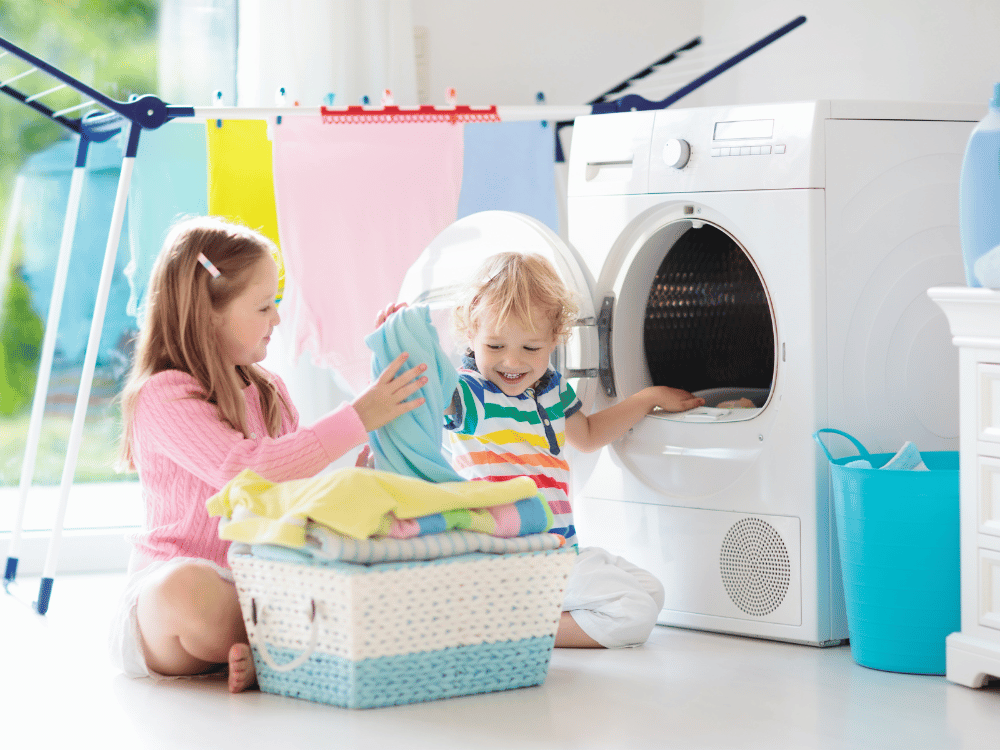
7. Help With Laundry
Younger kids might:
- Carry lightweight dirty clothes to the laundry area.
- Match socks.
- Sort clothing with help.
- Put clean clothes into drawers.
Older children may gradually learn more of the laundry process with appropriate instruction and supervision.
8. Keep the Shoe Area Tidy
If your family keeps shoes in a specific place, make your own shoes part of your responsibility.
Once that becomes easy, you may be able to help straighten the whole area.
9. Help With Trash
Depending on your age and what your family considers safe, you may be able to empty a small wastebasket or help bring an appropriate trash container to its usual location.
Ask an adult before handling anything heavy, sharp, messy, or potentially unsafe.
Do One New Responsibility at a Time
If you are just beginning, a list of fifteen new chores can feel overwhelming.
Try adding one responsibility first.
For example:
This week: Put dirty clothes in the hamper every day.
Once that becomes easier to remember:
Next week: Add putting your school bag by the door each evening.
Gradually adding responsibilities gives you time to practice each routine instead of trying to remember everything at once.
This matches guidance from the American Academy of Pediatrics, which recommends introducing one new chore at a time when a school-age child is new to household responsibilities.
Try to Notice What Needs Doing
One of the next levels of responsibility is moving from:
“Tell me what to do.”
toward:
“I know what needs to happen next.”
For example, you notice:
- Your shoes are in the middle of the floor, so you put them away.
- Your water bottle needs to go into your school bag, so you pack it.
- You finished using a game, so you return it before starting something else.
- The pet bowl is part of your evening job, so you check it at the agreed time.
This kind of initiative is part of becoming a self-starter: noticing an appropriate next step instead of always waiting for another person to prompt you.
Use a Reminder Until You Can Remember on Your Own
Needing a reminder while learning a new responsibility does not mean you cannot become responsible.
You can use:
- A chore chart.
- A checklist.
- A note near your backpack.
- A family calendar.
- A repeating reminder.
- A visual routine posted where you will see it.
HealthyChildren.org specifically recommends chore charts or lists as visual reminders that can help children remember household responsibilities.
If a printable visual system would help your family, the Efficiency Plan Responsibility Chart for Kids is one option for keeping everyday jobs visible.
Remember: A Reminder Is Not the Goal
At first, a parent might say:
“Remember to feed the dog.”
Eventually, the goal is for you to begin recognizing:
“It’s 5:00. This is one of my jobs.”
That transition takes practice.
A tool can help you remember, but over time you are learning to manage more of the responsibility yourself.
What If You Forget?
You probably will sometimes.
Everyone forgets things.
Responsibility does not mean pretending you never make mistakes.
If you forget a job, practice this:
- Own it: “I forgot.”
- Fix what you can: Complete the task if it can still be done.
- Think about why: Did you need a reminder? Was the routine unclear?
- Adjust: Decide what will help you remember next time.
That is much more responsible than automatically saying:
“Nobody reminded me!”
Learn to Manage Your Time Too
As you grow, responsibility becomes less about one simple chore and more about managing several things at once.
You might have:
- Homework.
- Sports.
- Music practice.
- A household job.
- Time with friends.
- Something you want to do just for fun.
Learning when those things need to happen is another part of growing independence.
These time-management strategies for kids and teens can help you begin organizing responsibilities without trying to remember everything in your head.
Taking Responsibility Does Not Mean Doing Everything Alone
There will be jobs you do not know how to do yet.
That is normal.
A responsible question might be:
“Can you show me how to do this?”
Or:
“Can I try the first part while you watch?”
Asking for instructions or supervision is especially important with anything involving:
- Sharp objects.
- Hot appliances.
- Cleaning chemicals.
- Heavy objects.
- Outdoor equipment.
- Anything your parent or caregiver has told you requires adult supervision.
Being responsible includes knowing when you are not supposed to handle something by yourself.
Ask for More Responsibility the Responsible Way
If you feel ready to do more, you can ask.
Instead of simply saying:
“I want more freedom.”
try:
“Is there something else I could learn to handle on my own?”
You might talk with your parent or caregiver about:
- A household job you can learn.
- Something you can begin remembering independently.
- A part of your morning or evening routine you can manage yourself.
- Something you can prepare for school without help.
This is one form of building personal agency: gradually participating more actively in the choices and responsibilities that are appropriate for you.
Responsibility Is Also About Other People
Household chores are not only individual achievements.
They are part of living with other people.
When everyone contributes, ordinary family life becomes easier to manage.
You can ask:
“What happens if everybody leaves this job for someone else?”
That question is also the idea behind What If Everybody Did That?, a children's book that explores how individual choices can affect everyone around us.
Try the Responsibility Ladder
Think of responsibility as a ladder.
You do not jump directly to the highest rung.
- Learn it: Someone shows you how.
- Practice it: You do it with help.
- Remember it: You begin doing it with fewer reminders.
- Own it: You know it is your responsibility and complete it.
- Notice it: You begin recognizing appropriate things that need to happen without always being told.
You may be on different rungs for different responsibilities.
You might independently manage your bedroom but still need help preparing food.
That is okay.
Responsibility grows gradually.
A Five-Question Responsibility Check
When you want to become more responsible, ask:
- What already belongs to me?
- What can I begin doing with fewer reminders?
- What new responsibility am I ready to learn?
- What reminder or routine could help me succeed?
- When do I still need an adult's help or supervision?
The Takeaway
You do not become responsible by suddenly doing everything yourself.
You build responsibility by practicing.
Take care of what belongs to you.
Help with appropriate family responsibilities.
Use reminders while you are learning.
Try to remember without being asked.
Own your mistakes.
Ask for help when you need it.
And gradually take on more as your skills grow.
Being responsible is not about proving that you can do everything. It is about showing that you can learn to take good care of the things that are appropriately yours to handle.
— Ashley Everhart
Founder, Efficiency Plan
Quick Questions About Responsibility for Kids
What responsibilities are appropriate for kids?
Responsibilities should match a child's age, abilities, maturity, and family situation. Younger children may begin with simple jobs such as putting toys away, placing dirty clothes in a hamper, helping set the table, or watering plants. As skills develop, children can gradually learn more complex household and personal responsibilities with appropriate instruction and supervision.
What if a child keeps forgetting chores?
Learning responsibility takes practice. A chore chart, checklist, consistent routine, or other visual reminder can help while the habit is developing. Introduce responsibilities gradually, make expectations clear, and help the child identify a system that makes remembering easier instead of expecting perfect independence immediately.
Does taking responsibility mean kids should do chores without help?
No. Children are learning, and some responsibilities require instruction, supervision, or adult involvement. A child can take meaningful ownership by practicing, asking questions, remembering appropriate tasks, and gradually doing more independently while still getting help when a task is unfamiliar or unsafe to perform alone.