
Why Open Loops Happen (Even When You’re a Good, Capable Employee)
Most open loops at work are not caused by disengagement, laziness, or a lack of care.
They happen because capable people are operating in a constant state of task triage — where speed, volume, and visibility quietly replace closure as the definition of success.
You’re trying to be responsive.
You’re trying to be helpful.
You’re trying not to create problems or slow things down.
And in fast-moving environments, that pressure changes how work gets handled.
What This Looks Like in Real Life
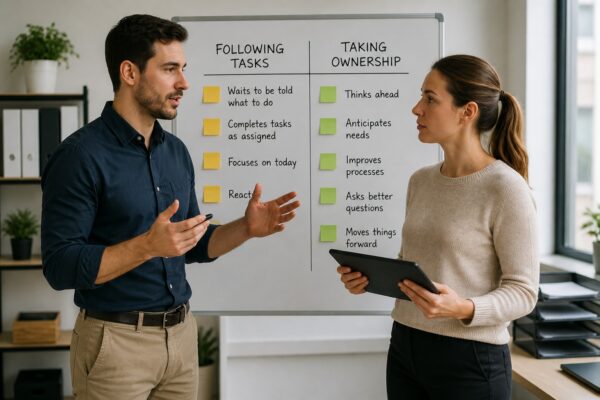
Instead of fully owning a few things to completion, work gets spread thin across many tasks.
Progress is real.
Effort is real.
But closure keeps slipping.
Not because you don’t want to finish — but because finishing often requires slowing down, deciding, and committing.
And commitment can feel risky.
The Quiet Forces Working Against Closure
Across teams, open loops tend to form for very specific reasons:
- Work gets optimized for showing activity, not closing outcomes.
- Status check-ins reward visibility, not finality.
- Decisions feel consequential, so pausing feels safer than committing.
- It’s easy to assume someone else will pick it up later.
- Too many concurrent threads means nothing gets the final 10%.
- Tasks get moved just enough to avoid looking stale.
- Drafting or prepping feels like progress even when nothing is finalized.
- The cost of reopening context later isn’t felt in the moment.
- Uncertainty isn’t escalated to “avoid bothering leadership.”
- There isn’t a hard, shared definition of what “done” means.
- Urgency signals push multitasking even when it isn’t required.
- Decision fatigue leads to delay at the finalization point.
- Keeping options open feels safer than committing and being wrong.
None of this makes you incompetent.
It makes you human inside a system that hasn’t yet made closure non-negotiable.
The Difference Between Progress and Completion
This is the shift that matters most:
Progress describes effort.
Completion changes the state of work.
Leaders generally know where things stand. What they’re listening for is movement — decisions made, actions taken, loops closed.
A task doesn’t become lighter until it’s finished, documented, or intentionally handed off. Until then, someone is still carrying it — often multiple people.
Why Open Loops Feel Safer Than Closure
Closure requires judgment.
It requires deciding:
- “This is done.”
- “This is the next step.”
- “This is what I chose.”
- “This is where it lives now.”
When you’re unsure, overloaded, or fatigued, keeping things open can feel protective.
Over time, though, that habit creates more pressure, not less.
What Strong Operators Do Differently
High-trust employees don’t just move tasks — they close them.
That means:
- finishing when possible
- documenting when not
- scheduling next steps instead of narrating uncertainty
- handing work off clearly instead of assuming continuity
They don’t wait for perfect certainty. They move work out of the system.
A Practical Check Before You Update or Report
Before sharing an update, pause and ask:
- Did something materially change?
- Can the next person understand this without asking me?
- Is the next action clear, owned, and visible?
- Have I done enough that this won’t bounce back later?
If yes — you’re closing the loop.
A Fair but Honest Truth
You are not failing.
You are acting like capable operators in a system that has not yet made closure discipline non-negotiable.
When closure becomes the standard — not speed, not visibility, not activity — work gets lighter, trust increases, and decision confidence grows.
That’s when effort finally turns into momentum.
Recommended Personal Growth Resources
Strong operators build strong systems — not just at work, but personally. If you're intentionally developing better focus, clarity, and disciplined execution, I’ve curated a collection of practical personal growth books and tools that support that kind of mindset.
You can explore the full board here:
If you found this helpful, you’ll likely find more practical, usable guidance throughout EfficiencyPlan.com. The site is intentionally built so leaders and team members can learn the same framework and grow together.