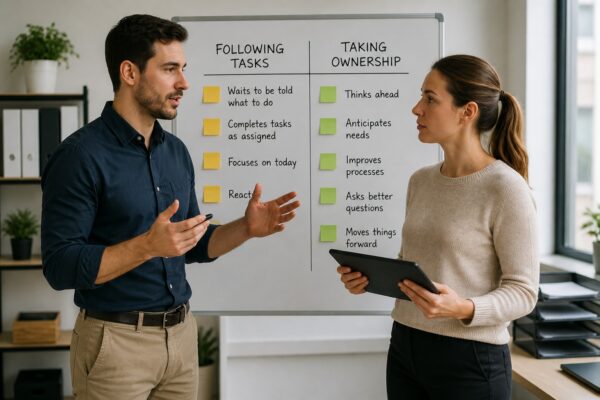
Being busy and being productive are not the same thing.
You can answer emails, reorganize your files, check three notifications, adjust your task list, refill your coffee, and spend 20 minutes “getting ready to work”—without making meaningful progress on the thing that actually matters.
We call this piddling.
Piddling is not simply doing small tasks. Small tasks can be necessary and valuable.
The problem is using low-value activity to avoid higher-value work.
The goal of productivity is not to do more things. It is to move the right things forward.

What Is Piddling?
Piddling happens when you appear to be working but repeatedly spend your attention on things that are easier, more interesting, or less uncomfortable than your real priority.
For example:
- Checking email again before beginning an important project.
- Reorganizing your desk when a difficult report is due.
- Changing the formatting of your task list instead of completing the tasks.
- Researching something far beyond what the assignment actually requires.
- Responding immediately to every notification while important work waits.
- Completing five easy tasks because one difficult task feels uncomfortable.
None of these activities is automatically bad.
The question is:
“Is this the best use of my attention right now?”
The Productivity Trap: Easy Work Feels Productive
Small tasks give us something psychologically attractive:
completion.
You answer an email.
Done.
You rename a file.
Done.
You update your calendar.
Done.
Meanwhile, the strategic proposal requiring two hours of concentrated thought remains untouched.
This is why a long completed task list does not necessarily tell you whether you had a productive day.
Being Productive vs. Being Busy explores this distinction in more detail.
Step 1: Decide What Would Make This Work Session Successful
Before beginning, identify the outcome that would make the session worthwhile.
Instead of writing:
“Work on presentation.”
try:
“Finish the first five slides and send them for review.”
Instead of:
“Catch up on finances.”
try:
“Reconcile the July account and identify any unexplained differences.”
The more clearly you define the finish line, the easier it becomes to notice when you are drifting away from it.
Step 2: Choose One Main Priority
You may have ten things you would like to accomplish today.
That does not mean all ten deserve equal attention right now.
Ask:
- Which task has the most meaningful consequence?
- Which task is blocking someone else?
- Which deadline is real?
- Which task requires my best concentration?
- Which important task am I most tempted to avoid?
Choose one primary outcome first.
You can still complete other tasks later.
Planning your priorities before the day becomes reactive is one of the principles in Plan Your Week Like a CEO.
Step 3: Define the First Physical Action
Sometimes we piddle because the important task is too vague.
“Create marketing strategy” is not an obvious action.
But these are:
- Open last quarter's campaign report.
- Write down the three campaign goals.
- Review the customer data.
- Draft the first section.
If you keep avoiding something, ask:
“What is the smallest concrete action that would count as starting?”
Then do that.
Step 4: Stop Using Preparation as Procrastination
Preparation is useful when it helps you perform the work.
It becomes piddling when preparation repeatedly replaces the work itself.
You probably do not need to:
- Find the perfect playlist.
- Completely clean your desk.
- Research seven productivity systems.
- Buy another notebook.
- Redesign your task-management system.
before writing the first paragraph.
A useful question is:
“Do I actually need this before I can begin?”
If the answer is no, start.
Step 5: Reduce Unnecessary Task Switching
You begin writing.
An email notification appears.
You check it.
Then you remember a different task.
You open another tab.
Then someone sends you a message.
Twenty minutes later, you return to the original document and have to remember what you were thinking.
Research summarized by the American Psychological Association has found measurable costs when people repeatedly switch between tasks. Even when the individual switching cost is small, repeated switching can accumulate over time, particularly with more complex tasks.
You can read the APA overview on multitasking and task-switching costs.
You do not need to eliminate every interruption from your life.
But you can reduce unnecessary ones.
- Silence nonessential notifications.
- Close tabs you do not need.
- Put your phone away when appropriate.
- Tell coworkers when you need uninterrupted concentration.
- Keep unrelated ideas on a quick capture list instead of immediately pursuing them.
Step 6: Give Small Tasks Their Own Time
The solution is not to eliminate every small task.
Email needs to be answered.
Documents need to be filed.
Forms need to be completed.
Administrative work still matters.
Instead of allowing those activities to interrupt your day continuously, consider grouping similar small tasks into a defined period.
For example:
- Process routine emails together.
- Handle invoices in one block.
- Return nonurgent calls together.
- Update records during one administrative period.
This approach is often called batching. What Is Batching? explains how grouping similar work can reduce the constant start-stop pattern of scattered tasks.
Step 7: Use a Timer If It Helps You Start
Timers can be useful when a task feels difficult to begin.
You might tell yourself:
“I am going to work only on this for the next 20 minutes.”
Or:
“I will work until 10:30 and then decide whether I need a break.”
The popular Pomodoro approach often uses 25 minutes of work followed by a short break, but there is no reason every person or task must use exactly that schedule.
Deep analytical work may benefit from a longer block.
An unpleasant administrative task may feel easier with a shorter one.
The timer is a boundary for your attention, not a rule you have to obey perfectly.
Step 8: Make Distractions Slightly Harder
You do not always need heroic willpower.
Sometimes changing the environment is easier.
If your phone repeatedly pulls your attention away, move it farther from you.
If a social-media tab keeps attracting you, close it.
If notifications are unnecessary during concentrated work, silence them.
If coworkers constantly interrupt because they do not know when you are available, create a clearer communication routine.
The objective is not to create a distraction-free universe.
It is to remove some of the unnecessary invitations to switch tasks.
Step 9: Keep a “Not Now” List
Distractions are not always external.
Sometimes your own brain interrupts you.
While writing a proposal, you suddenly remember:
- You need to order printer ink.
- You should email someone.
- You have an idea for another project.
- You want to research a new software tool.
Instead of stopping your current work, write the thought on a short capture list.
You are telling yourself:
“This may matter. It just does not matter right now.”
Review the list when your focus block ends.
Step 10: Notice Productive Procrastination
One of the sneakiest forms of piddling is doing something genuinely productive to avoid something more important.
You clean the entire kitchen instead of preparing the presentation.
You answer every email instead of making the difficult phone call.
You organize next month's project instead of finishing today's deadline.
The activity itself may be useful.
The timing is the problem.
Ask:
“If the difficult task disappeared, would I still choose to do this right now?”
If the answer is no, you may have found productive procrastination.
Step 11: Know When a Small Task Really Does Come First
Do not become so obsessed with “deep work” that you ignore legitimate quick responsibilities.
A two-minute task may deserve immediate attention when:
- Someone else cannot continue until you respond.
- Delay creates unnecessary risk.
- It closes an important communication loop.
- The task is genuinely time-sensitive.
The distinction is not:
Big task = important.
Small task = unimportant.
The better question is:
“What deserves my attention now?”
Step 12: Protect Your Best Attention
Not every hour of your day feels the same.
If you know there is a time when you think more clearly, consider protecting at least some of it for work that benefits from concentration.
Use lower-energy periods, when possible, for work such as:
- Routine administration.
- Filing.
- Scheduling.
- Simple responses.
- Other lower-complexity tasks.
This is not possible in every job, but even limited control over when different kinds of work happen can help.
Step 13: Finish Before Optimizing
Perfectionism can look surprisingly similar to productivity.
You keep:
- Editing.
- Formatting.
- Researching.
- Adjusting.
- Improving.
But the work never reaches the point where anyone can use it.
Ask:
“What level of quality does this particular outcome actually require?”
A client proposal deserves more attention than an internal reminder email.
Productivity includes matching the level of effort to the importance of the outcome.
Step 14: End With a Short Review
At the end of a focused work period, ask:
- What did I intend to accomplish?
- What actually moved forward?
- Where did my attention drift?
- What is the next logical action?
Do not turn this into another 30-minute productivity ritual.
A minute or two may be enough.
The goal is to learn what makes productive work easier for you.
Try the Piddling Test
If you catch yourself working but not progressing, ask these five questions:
- Priority: What matters most right now?
- Progress: Is what I am doing moving that priority forward?
- Avoidance: Am I doing this because the important task feels harder?
- Next action: What is the smallest useful step I could take instead?
- Environment: What distraction can I remove before I begin?
If you repeatedly answer that your current activity is not moving the important work forward, you probably do not need another productivity hack.
You need to return to the priority.
A Visual Timer Can Help Create a Focus Boundary
You do not need a special tool to work in focused intervals. The timer on your phone or computer may be enough.
If you prefer seeing the remaining time visually, TIME TIMER MOD is one optional tool we have recommended for creating visible work intervals.
The important part is not the timer itself.
It is deciding what deserves your attention during that period.
More Tools for Planning Focused Work
If printable planners, priority sheets, trackers, and productivity worksheets help you keep important work visible, explore the Efficiency Plan Etsy Shop.
The Takeaway
Maximizing productivity does not mean squeezing productive activity into every minute of the day.
It means becoming more intentional about where your attention goes.
Define the outcome.
Choose the priority.
Identify the first action.
Reduce unnecessary switching.
Batch low-value administrative work when it makes sense.
Use timers if they help.
And notice when seemingly productive activity is actually helping you avoid the work that matters most.
The opposite of piddling is not constant hustle. It is knowing what deserves your attention and giving it enough focused action to move forward.
— Ashley Everhart
Founder, Efficiency Plan
Quick Questions About Maximizing Productivity
What is the difference between being busy and being productive?
Being busy describes activity. Productivity is more concerned with whether that activity moves a meaningful priority or outcome forward. Small administrative tasks can be productive when they genuinely need to be completed, but they can also become a form of avoidance when they repeatedly replace more important work.
Is multitasking bad for productivity?
For complex work, repeatedly switching between tasks can create additional cognitive costs because you have to disengage from one set of goals and rules and reorient yourself to another. Reducing unnecessary task switching can therefore make concentrated work easier, although not every job allows uninterrupted focus for long periods.
Do I have to use the Pomodoro Technique to be productive?
No. Timed focus intervals are simply one tool. Twenty-five minutes of work followed by a short break may work well for some people and tasks, while others benefit from longer or shorter periods. Choose an interval that helps you begin, concentrate, and complete meaningful work rather than treating one timing formula as a universal rule.